






Lasers have
made a huge impact on student project work but we are often asked “Why can’t they be used to cut metals?” In
industry, lasers are used routinely for metal-cutting, but high costs and significant risk management issues
make the technology unsuitable for educational use – at least at the moment! To meet the need for metal
profiling in education, TechSoft are delighted to introduce PlasmaCUT.| Plasma-Cutting Torch: | Thermal Dynamics Cutmaster A40 |
| Piercing Thickness: | Up to 12mm mild steel |
| Power Output: | 20-60A for smooth clean cuts |
| Inverter Design: | Constant current output |
| Axis Travel: | 1000 x 1000mm |
| Max Head Speed: | 267mm/sec (16,000mm/min) |
| Interface (to PC Controller): | USB or Ethernet |
| Dimensions (including safety case): | 1680(W) x 1600(D) x 1780(H)mm |
| Weight: | 575kg |
| Power Requirements: |
PlasmaCUT: 415V 32A Compressor & PC: 2 x 240V 5A Extraction Unit: 240V 16A |
Lasers have made a huge impact on student project work but we are often asked “Why can’t they be used to cut metals?” In industry, lasers are used routinely for metal-cutting, but high costs and significant risk management issues make the technology unsuitable for educational use – at least at the moment! To meet the need for metal profiling in education, TechSoft are delighted to introduce PlasmaCUT... [more]
Lasers have made a huge impact on student project work but we are often asked “Why can’t they be used to cut metals?” In industry, lasers are used routinely for metal-cutting, but high costs and significant risk management issues make the technology unsuitable for educational use – at least at the moment! To meet the need for metal profiling in education, TechSoft are delighted to introduce PlasmaCUT.
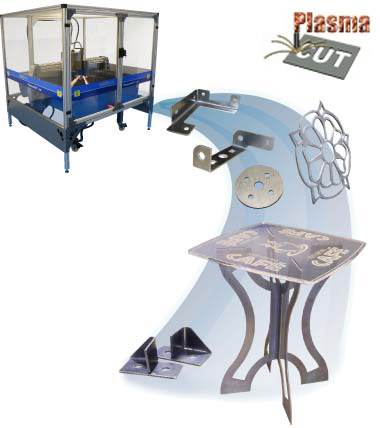
PlasmaCUT gives you all the simplicity and speed of laser cutting but without the cost and safety problems associated with high power metal-cutting lasers. PlasmaCUT is a high speed profiling machine that works from 2D CAD files generated in 2D Design V2. Output routine is much the same as any TechSoft machine, but now you can slice your way through mild steel, up to 6mm thick, with no more hassle than it took to slice through card on a CAMM 1.
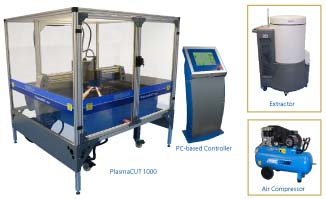
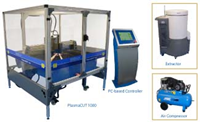
Safety is paramount of course and cutting mild steel has a few more concerns than card-cutting. PlasmaCUT is UK-built and CE marked to meet exacting EU regulations for Health and Safety, and TechSoft have worked closely with the manufacturers to take things even further. The machine is housed in an interlocked protective enclosure with tinted panels to shield from flash, and to contain stray sparks and particles. There is an integral down-draft fume table and this connects to a high-efficiency extraction system which captures all gas and airborne particulates. The extraction unit filters and completely cleans the waste so that it can be safely exhausted internally. PlasmaCUT is not a machine for a regular classroom or design studio, but will fit into any workshop space where there are the usual provisions for hot metal working.
Engineering departments and specialist engineering schools will clearly be interested in the potential PlasmaCUT has to bring sheet metal cutting up to date with industry-standard CAD/CAM techniques. More widely, many Design and Technology departments have found metalworking quite difficult to incorporate into schemes of work in recent years. PlasmaCUT will fit naturally alongside other CAD/CAM and ‘benchwork’ techniques, and has the power to revolutionise what students are able to do in their project work.
TechSoft’s unrivalled knowledge and experience mean that these machines are not simply compatible with, but have been optimised for the UK education market. We are proud of our reputation for excellent customer service and our close liaison with the UK manufacturers means you will have access to unlimited technical support should you need it. If you know how to operate one TechSoft machine you will be well on your way to using PlasmaCUT.
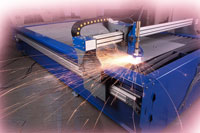
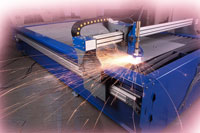
We are used to three energy states for materials - solid, liquid or gas. Plasma is a fourth state where energy levels are raised further, and gas molecules break into free electrons and positive ions. When these particles collide, enormous energy is released and this is the basis of a Plasma beam. PlasmaCUT uses an inverter-driven plasma torch which creates the beam by forming an electrical arc in a high-velocity, highly focussed jet of compressed air, and it is this which so easily pierces mild steel sheet.
The main chassis of PlasmaCUT is built from precision-cut steel for rigidity, with aluminium being used where possible for the motion system. By keeping mass low, the motion system can accelerate rapidly which results in accurate hole-cutting and clean corners. The plasma torch is held on a pneumatically-operated cutter post which gently presses onto the work with five rollerball units; this ensures the torch is consistently held at the right height for clean cutting and easy starting.
PlasmaCUT has its own PC-based controller accessed through a 15” LCD touch screen. This is used to import files from 2D Design V2 ready to machine.
PlasmaCUT machines are commissioned on-site by trained engineers who will remain for as long as necessary to ensure teaching and technician staff are happy with all operation, safety and maintenance issues. Maintenance is largely a matter of ‘housekeeping’ - the fume table will need to be cleared of off-cuts and dust from time to time, and bearing surfaces and slides will need to be wiped clean. The compressor and extraction system will also need monitoring to check that connections are good and filters are serviceable.
PlasmaCUT draws about 10A from its mains supply (much the same current as boiling a kettle) so cost will depend on length and frequency of use. Using a PlasmaCUT is unlikely to have a significant impact on energy costs in most schools. Filters in the extraction system will need replacement but, again, how often will depend on use. The plasma torch will last indefinitely, but the main electrode and nozzle will need replacing after about 500 piercings. Replacements are not expensive and, combined with filter costs, an annual budget of a few hundred pounds should be more than enough to keep a PlasmaCUT going in a busy department.
| MP6-PC-1T | TechSoft PlasmaCUT 1000 with safety case, extractor (worth £2,595), air compressor (worth £399), commissioning and training | 20,995.00 | ![]() |
| 2D Design V2 | More Information |
The cost of the PlasmaCUT also includes commissioning and training on the same day.
| UK Mainland & Ireland: | 2 Year On-Site |
| Elsewhere: | 2 Year Return and Collect |
The 2 year warranty covers all electrical and mechanical systems and the plasma torch, but not the torch electrode and nozzles which are deemed 'consumable'.